
Craft & Process
How Handmade Metal Bells Are Made: Inside the 5-Step Rasaai Process
From iron sheet to a singing bell: how our artisans in India forge, coat, kiln-fire, finish and hand-tune every bell, and what the Rasaai finish means for buyers.
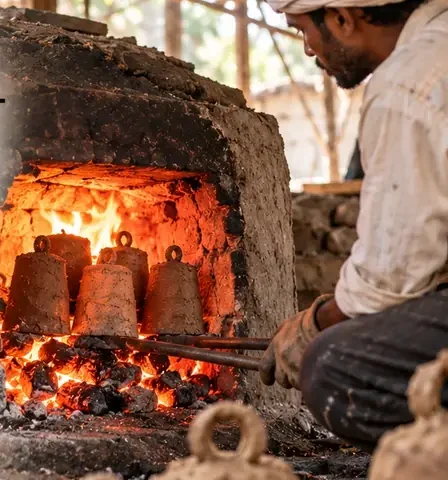
Short answer: a handmade metal bell starts as a scrap of iron sheet. An artisan hammers it into a bell shape by hand, wraps it in clay mixed with brass and copper powder, fires it in a charcoal kiln, cracks off the baked clay, and then tunes the bell by ear with a hammer. At Nifa Overseas we call this the Rasaai process. It gives every bell a golden-bronze finish that is fused into the metal, not painted on.
This guide walks through each of the five steps, and explains what they mean if you are buying handmade bells for a store, a catalogue or a private-label range.
Where the Rasaai Technique Comes From
Our bells follow a traditional Indian technique known for the copper-coated iron bells of Kutch. It has been practised by Lohar (blacksmith) artisan families for generations. Nothing in the process depends on a factory line: the shape, the finish and the sound all come from an artisan's hands, a kiln and a trained ear.
We make these bells in our workshop in Roorkee, Uttarakhand, and export them to importers, wholesalers and retailers in the USA, Europe and other markets.
Step 1: Forging the Body
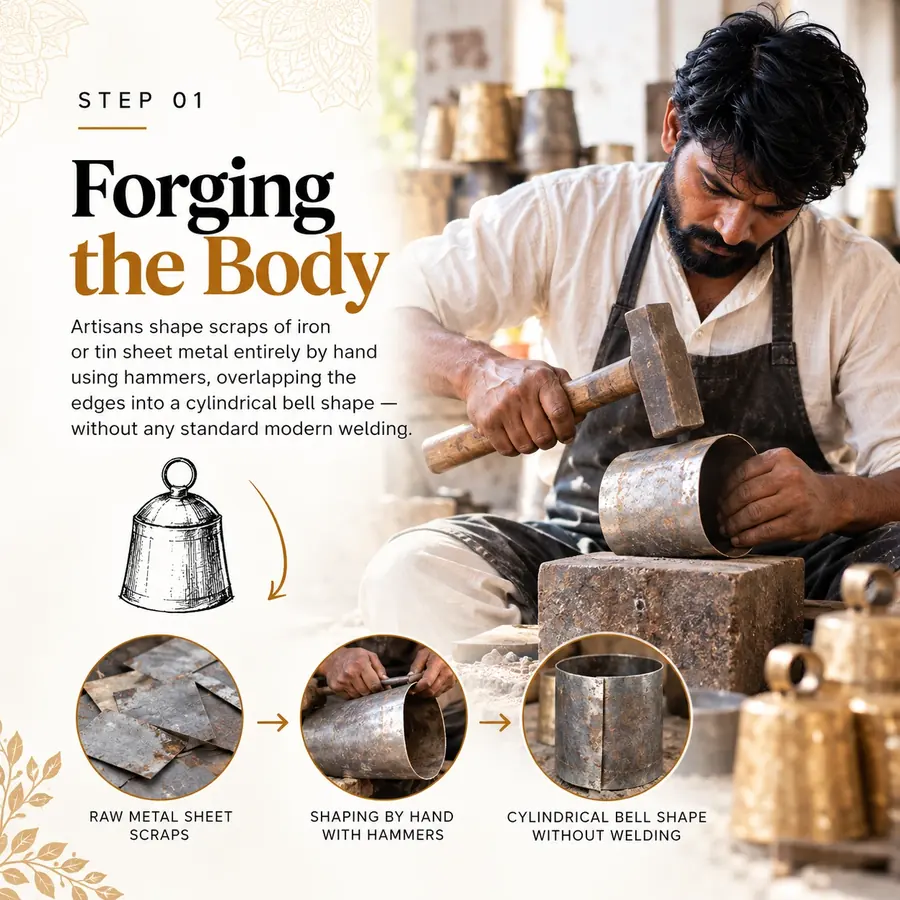
Artisans shape scraps of iron or tin sheet metal entirely by hand using hammers. They overlap the edges into a cylindrical bell shape, without standard modern welding.
- Raw metal sheet scraps are the starting material.
- The body is shaped by hand with hammers.
- The cylinder is formed by overlapping the edges, not by welding.
Because every body is hammered by hand, no two bells have exactly the same outline. That is the first reason handmade bells look and sound slightly different from each other.
Step 2: The Metal Blend Coating
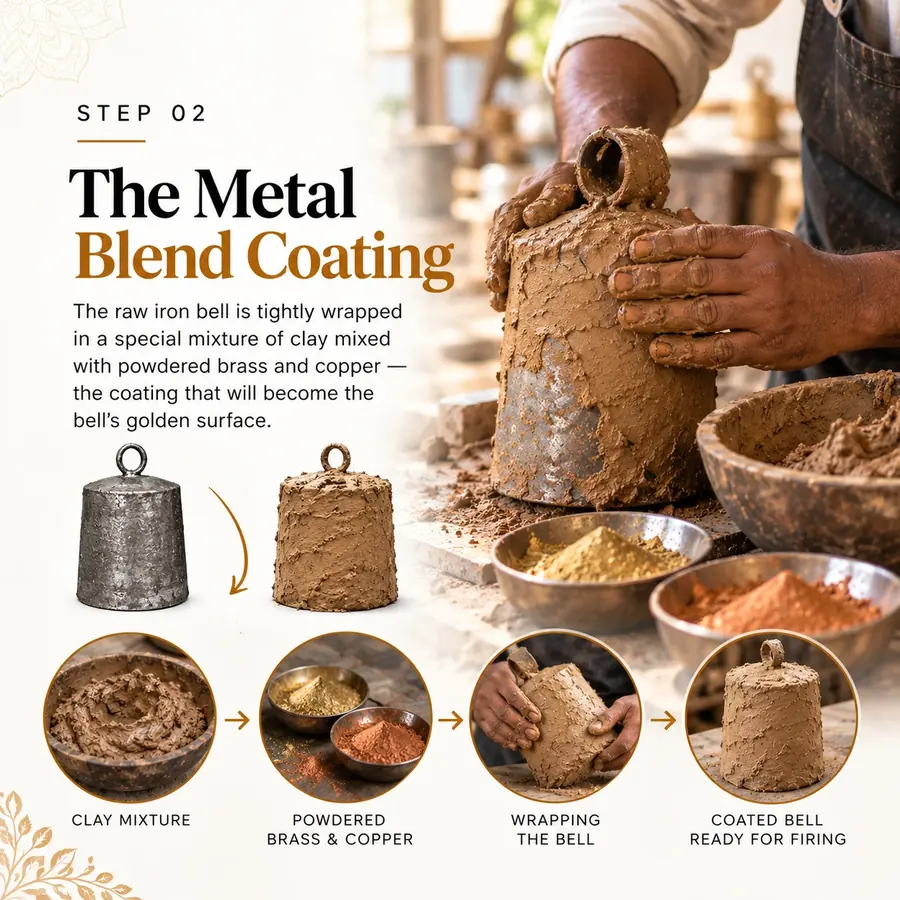
The raw iron bell is tightly wrapped in a special mixture of clay mixed with powdered brass and copper. This layer is what will become the bell's golden surface.
At this stage the bell looks nothing like the finished product. It is a lump of wet mud, ready for the fire.
Step 3: Kiln Firing, the Fusion
The mud-wrapped bell goes into a high-temperature charcoal kiln. As it bakes, the clay acts as a natural furnace mould. It traps the heat so the brass and copper powder melt completely and are absorbed into the porous surface of the hot iron.
This is the heart of the Rasaai process. The colour is not applied on top of the iron. It is fused into the surface of the metal by fire.
Step 4: Cooling and Finishing
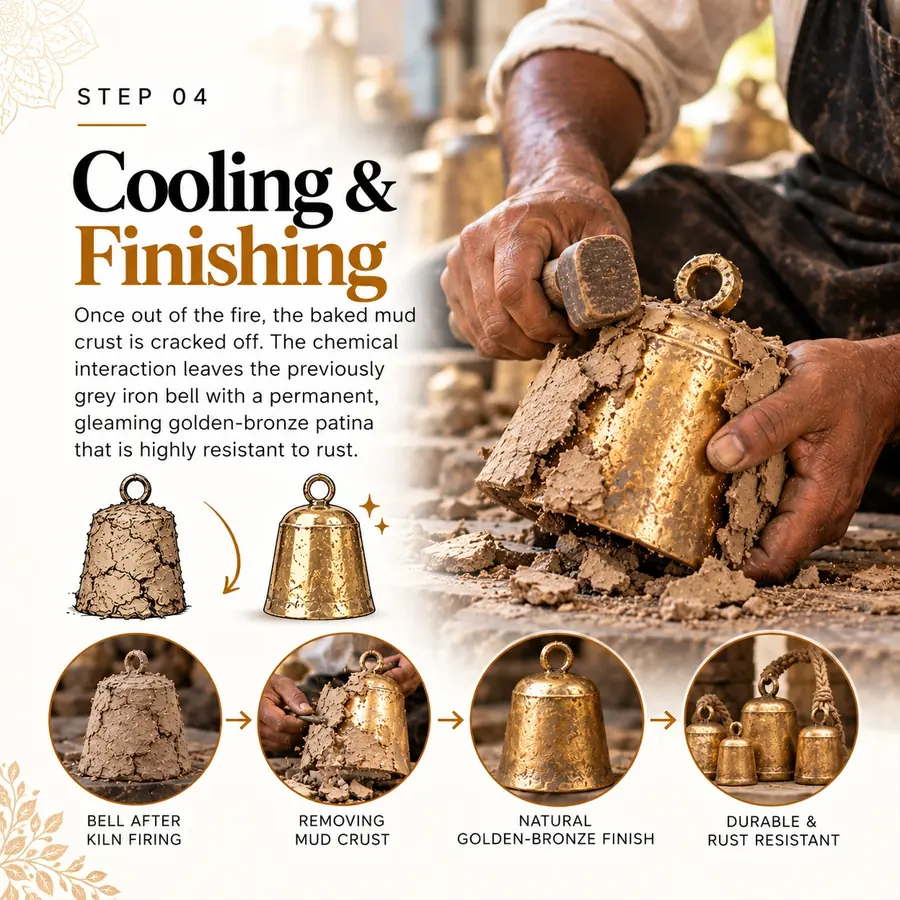
Once out of the fire, the baked mud crust is cracked off. The interaction in the kiln leaves the previously grey iron bell with a permanent, gleaming golden-bronze patina that is highly resistant to rust.
The finish varies from bell to bell: some come out more golden, some more bronze, some with darker patches where the clay sat differently. Buyers who know handmade decor value that variation, because it is impossible to fake on a production line.
Step 5: Hand Tuning
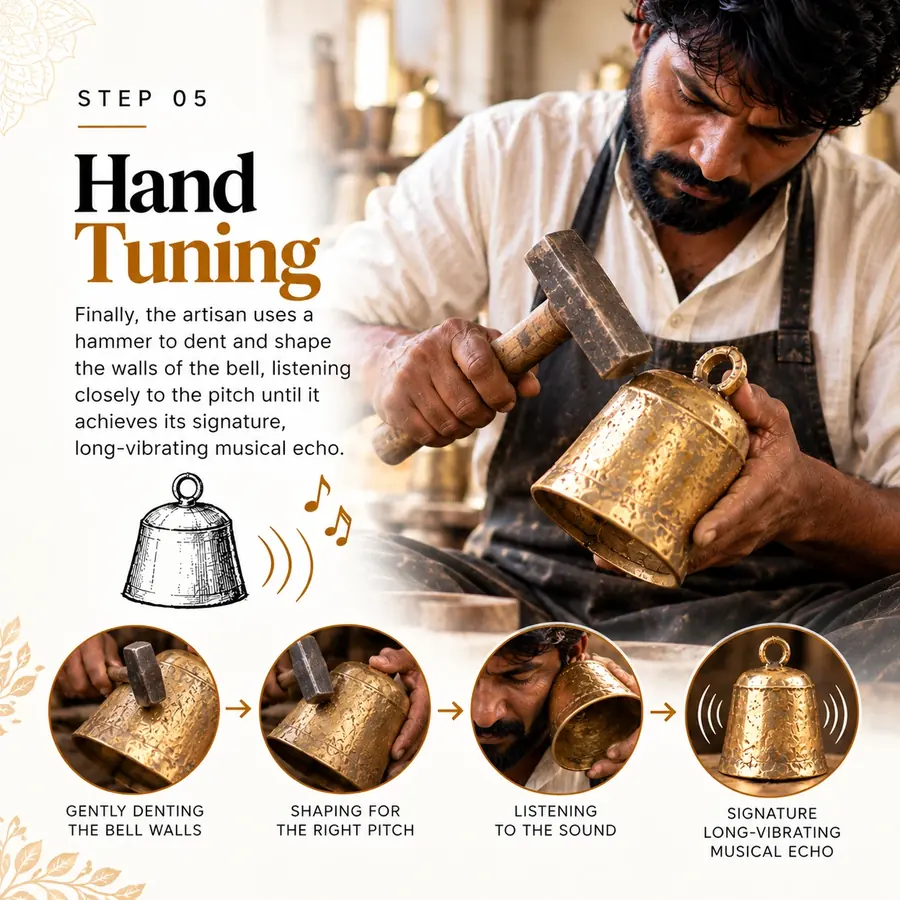
Finally, the artisan uses a hammer to dent and shape the walls of the bell, listening closely to the pitch. They keep adjusting until the bell gives its signature, long-vibrating musical echo.
This step is why a Rasaai bell rings rather than clanks. It is also why two bells of the same size can have slightly different tones.
Rasaai Finish vs Paint vs Plating
If you are comparing suppliers, it helps to know how the finish is made, because it decides how the bell ages.
| Rasaai (fire-fused) | Painted finish | Plated finish | |
|---|---|---|---|
| How it is applied | Brass and copper fused into the iron in a kiln | Paint layer sprayed or brushed on top | Thin metal layer deposited on the surface |
| Chipping and peeling | Does not chip or peel like paint | Can chip or scratch through | Can wear through at edges over time |
| Look | Rustic golden-bronze, every bell unique | Uniform colour | Uniform, shiny |
| Sound | Hand-tuned, long ringing tone | Depends on the bell | Depends on the bell |
What This Means for Wholesale Buyers
- Expect natural variation. Colour, texture and tone vary slightly from bell to bell. In handmade work that is the signature, not a defect. Mention it in your product listings so your customers expect it too.
- Sizes and shapes can be customised. Because each bell is formed by hand, size, shape, pattern and finish can be adjusted to your requirement for suitable quantities.
- Plan your timeline. Standard bulk orders take about 3–4 weeks to make, plus shipping time. For seasonal ranges such as Christmas bells, order well ahead of your selling season.
- Start small if you need to. Low MOQ is available on suitable designs, so you can test a design in your store before a full bulk order.
- Private label is possible. Your logo, labels and private-label packaging can be discussed for suitable quantities.
Caring for Rasaai Bells
The fire-fused finish is durable, but it is still a natural, rustic surface. To keep bells looking their best, store them dry, wipe them with a soft dry cloth, and avoid harsh chemical cleaners or polish, which can strip the patina. A bell that develops a deeper, darker tone over time is ageing naturally.
Order Handmade Rasaai Bells From Nifa Overseas
We make only handmade metal bells: rustic cow bells, Christmas bells, harmony and hanging bells, bell wind chimes, vintage bells, and custom or private-label bells. Download our catalogue to see the range, or send us your requirement and we will reply with designs, MOQ and a quote.
Frequently Asked Questions
What is the Rasaai process?
Rasaai is a traditional Indian technique for finishing iron bells. The hand-shaped iron bell is wrapped in clay mixed with brass and copper powder and fired in a charcoal kiln, so the brass and copper fuse into the surface of the iron and leave a golden-bronze finish.
Is the golden colour on handmade bells paint?
Not on Rasaai bells. The colour comes from brass and copper fused into the iron during kiln firing, so it does not chip or peel like paint.
Why does each handmade bell look and sound a little different?
Each bell is shaped, fired and tuned by hand, so the outline, colour and tone vary slightly from bell to bell. That variation is the mark of handmade work, not a defect.
Are Rasaai bells rust resistant?
The fire-fused patina is highly resistant to rust. To keep the finish at its best, store bells dry and clean them only with a soft dry cloth.
How long does a bulk order of handmade bells take?
About 3–4 weeks for standard bulk orders at Nifa Overseas, plus shipping time. The timeline is confirmed for every order.